
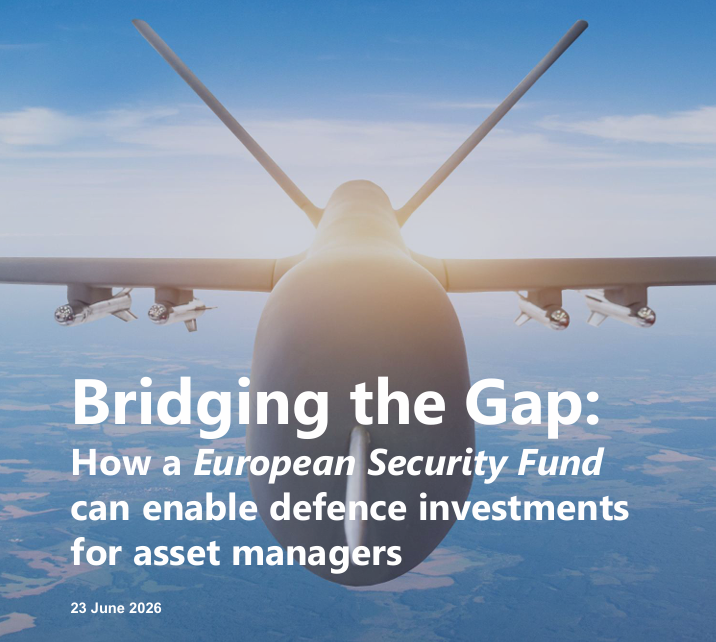
European defense spending is rising sharply due to geopolitical tensions. Within NATO Europe, budgets are expected to double to approximately €1 trillion by 2035. For the Netherlands, this will rise from €26 billion in 2025 (2.5% of GDP) to approximately €60 billion in 2035. At the same time, the composition of spending is shifting from personnel to technology, maintenance, and R&D.
Despite this growth, European production capacity continues to lag behind rising demand. According to a study by the European Commission, 40% of defense SMEs struggle to access financing, resulting in a financing gap of approximately €4 billion. Furthermore, the lack of publicly traded Dutch defense companies limits visibility into the sector and access for institutional investors, who primarily invest in liquid, publicly traded stocks.
Asset managers have significant investment capacity—in 2024, assets under management totaled €3,295 billion—but face structural barriers when investing in unlisted defense companies and small and medium-sized enterprises. These include mandate restrictions, a preference for liquid investments, more complex due diligence, unclear compliance frameworks, and mixed signals regarding ESG. For example, the AFM has expressed its opposition to labeling defense investments as ESG, while the European Commission states that defense can contribute to peace and fits within the European framework for sustainable finance. This lack of clarity makes it more difficult for asset managers to reach well-considered investment decisions.
The paper emphasizes that the sector is not excluded: a survey of DUFAS members shows that most asset managers invest in the defense sector, within clear frameworks that include exclusions focused primarily on controversial weapons. However, these investments are concentrated in publicly traded companies rather than in unlisted small and medium-sized enterprises (SMEs), where the need for financing is greatest.
As a possible solution, the paper outlines a European Security Fund, to be established by the European Commission and/or the European Investment Bank and aligned with the Savings and Investments Union (SIU). By bundling projects, sharing risks, and achieving sufficient scale, an ESF could serve as an investable platform that meets the requirements of asset managers and mobilizes private capital for the sector. The fund could operate alongside existing public instruments such as the European Defense Fund. Conditions for success include sound governance, risk-sharing, transparency, respect for human rights and international humanitarian law, and an appropriate expected return.