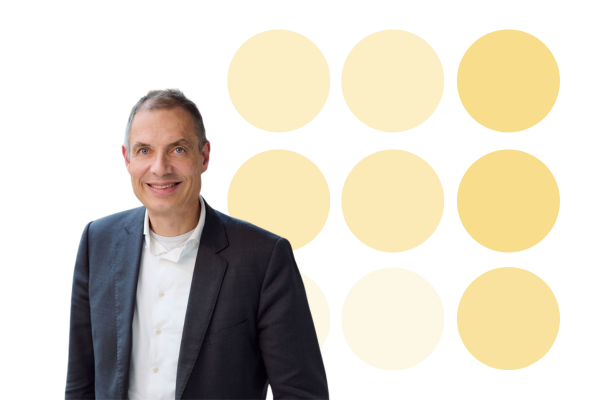
You are handing over the presidency of DUFAS. What do you look back on most proudly?
"When I became chairman, the asset management industry was not always judged on its own merits. We were often lumped in with other parts of the financial sector and sometimes still carried the image of the credit crisis. Whereas the problems at the time did not stem from the asset management sector.
What I like is that in recent years we have made much more visible what our industry actually does. Asset management is not an abstract activity for a small group of professionals. It touches virtually every Dutch person, for example through pension accrual, insurance or other financial products. That story is better understood today than it was four years ago."
Many people still see wealth management as something abstract. What are they missing?
"They often miss the social significance of it. Wealth management helps people build wealth for later. At the same time, it makes capital available for businesses, innovation, infrastructure and other investments needed for economic development.
For many people, investing is something they associate with risk. But the conversation should be more often about the risks of not investing. That perspective is still too often missing."
You say more often that risk aversion can also be a risk. What do you mean?
"The Dutch reflex is often: be careful. There is nothing wrong with that in itself. But sometimes we get bogged down in that. Then the image arises that investing is especially dangerous.
Of course there are risks. But if people invest long-term and spread their investments well, the chance of structural loss is relatively small. The risk of not investing gets much less attention, even though it can have major long-term consequences for wealth accumulation and financial independence.
So I sometimes say: not investing is often riskier than investing."
So that's because we are cautious. Where does this caution come from?
"That's a combination of factors. Culturally, the Dutch and Europeans are relatively reticent when it comes to risk-taking. In addition, regulations, supervision and sometimes tax incentives play a role.
Moreover, in the Netherlands we tend to make European rules just a little stricter than necessary. This does not always contribute to a climate in which investing becomes natural.
At the same time, you do see a change. Both policymakers and civil society organizations are increasingly realizing that investment is needed to enable future growth. That helps."
How do we get more people comfortable with investing?
"To a large extent, that starts with education. That's why DUFAS supports initiatives that introduce young people to investing and wealth accumulation at an early age.
But it's also about changing the social narrative. We need to talk not only about risks, but also about opportunities. About what investing makes possible for households as well as for the economy as a whole."
Europe plays an increasing role in DUFAS' work. Why, really?
"Because Europe is ultimately the market in which we operate. The Netherlands has a strong position within the European asset management industry. We are among the largest countries in Europe in terms of assets under management and have a lot of knowledge of long-term investing.
At the same time, we must be careful to keep looking at everything through a national lens. If Europe wants to remain competitive against the United States and Asia, we need to act more collectively."
In that regard, what have you learned from cooperation within Europe?
"That European cooperation sometimes means letting go of some of your own rightness. Within the European umbrella EFAMA, countries sometimes have different interests and traditions. Yet it is important to keep finding each other.
It is precisely on dossiers such as regulation, competitiveness and capital markets that Europe becomes stronger when countries act together. In unity ultimately lies strength."
DUFAS also supports the Savings and Investment Union. Why is that important?
"Europe has a lot of savings, but capital markets are still fragmented. As a result, capital is not always used optimally for investment.
The Savings and Investment Union can help make more private wealth productive for economic growth, innovation, infrastructure, the energy transition and defense. The Netherlands can play an important role in this thanks to its strong pension system and experience with collective wealth accumulation."
Which financial topics deserve the most attention in the coming years?
"Financial education remains important. In addition, we need to make investing more accessible to more people. Europe remains high on the agenda, as does the question of how to strengthen the competitiveness of our industry.
Furthermore, we must continue to look critically at the regulatory burden. Good supervision is essential, but regulations must remain proportionate.
And finally, we must ensure that the industry remains attractive to new talent. The asset management industry has a wonderful story to tell. We can be quite a bit less modest about that."
Your farewell marks a change of president. Does that also mean a new direction for DUFAS?
"I don't think so. Above all, I see continuity. The big themes remain the same: financial education, more private participation in investing, a strong position of the Netherlands in Europe and a healthy balance between supervision and room for entrepreneurship.
DUFAS has built a solid position in recent years. I am confident that that line will continue."